> For the complete documentation index, see [llms.txt](https://guides.clickatell.com/flow/llms.txt). Markdown versions of documentation pages are available by appending `.md` to page URLs; this page is available as [Markdown](https://guides.clickatell.com/flow/action-nodes/action-nodes-regular-expression.md).
# Regular Expression
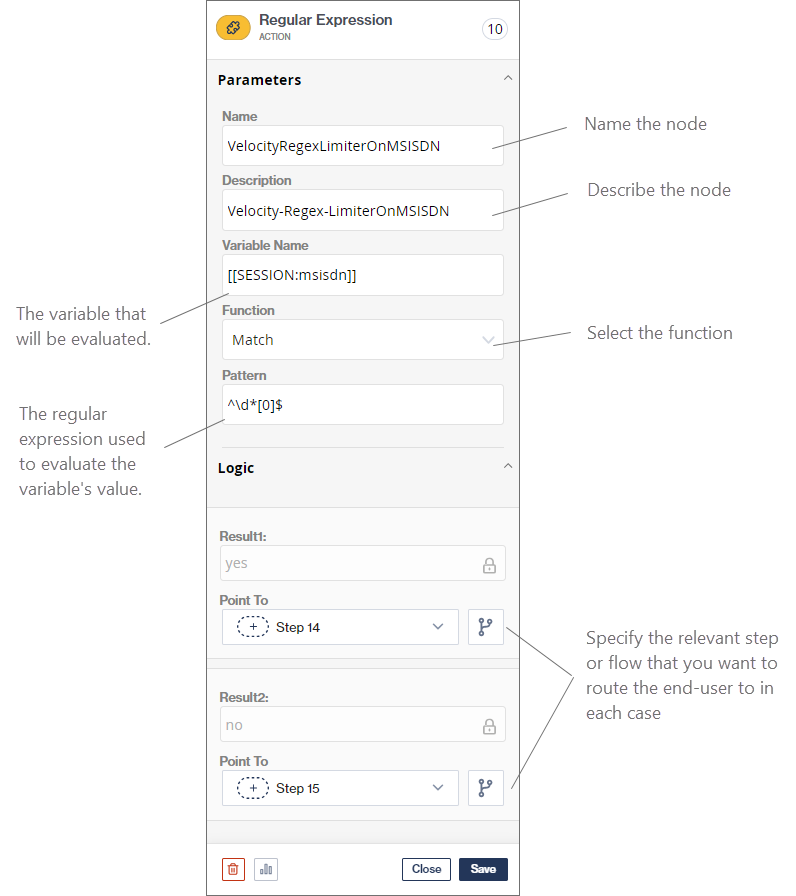
The *Regular Expression* node allows you to match variables to a regular expression pattern and define what action comes next (either route the customer to a new step in the workflow or trigger a new workflow).
Setup of a Regular Expression node
### Examples:
Below are examples of commonly-used regular expressions:
| Regular Expression | Description |
| -------------------------------------------------- | ----------------------------------------------------------------------------------------------------------------------- |
| ((19\|20)\\\d\\\d)-(0?\[1-9]\|\[12]\[0-9]\|3\[01]) | Evaluates that an input is in the date format yyyy-mm-dd |
| ^\[a-zA-Z0-0]{4,16}$ | Evaluates that an input is alphanumeric with a minimum of 4 and a maximum of 16 characters in length (e.g. a user name) |
| \[0-9]{4} | Evaluates that an input is a 4-digit numeric code |
| \[1\|2]{1} | Evaluates that an input is either 1 or 2 |
{% hint style="info" %}
For more information on regular expressions, see the links below:
* (ensure you've selected the *ECMAScript (JavaScript)* flavor on the left).
*
{% endhint %}